
Before the deposit leaves: what to prove about a Chinese supplier
The quote arrives with a factory video, a dozen product photos, and a payment request. The video starts at a gate and ends at a packing table. It could be any workshop in the same industrial park.
Nothing in that video tells you who will make your order, on which line, or what happens when the date slips. A factory audit before deposit is the visit that tries to answer those questions while the money is still in your account.
This is not a PSI story. PSI comes later, when there are cartons to open. This is the earlier decision: whether to send money to this supplier at all.
The question behind the deposit
Most buyers ask, “Is this a real factory?” That is the easy half. A trading company with a rented sample room can look like a factory for an afternoon, and a real factory can still be the wrong one for your product.
The harder question is whether the entity you pay is the entity that will make the goods, at the volume and date promised, with a process you have seen. A deposit buys a place on someone’s calendar, some control over how the goods are made, and a little recourse if they are not. When those three are unclear, the wire is a bet on a chat thread.
Match the money to the entity
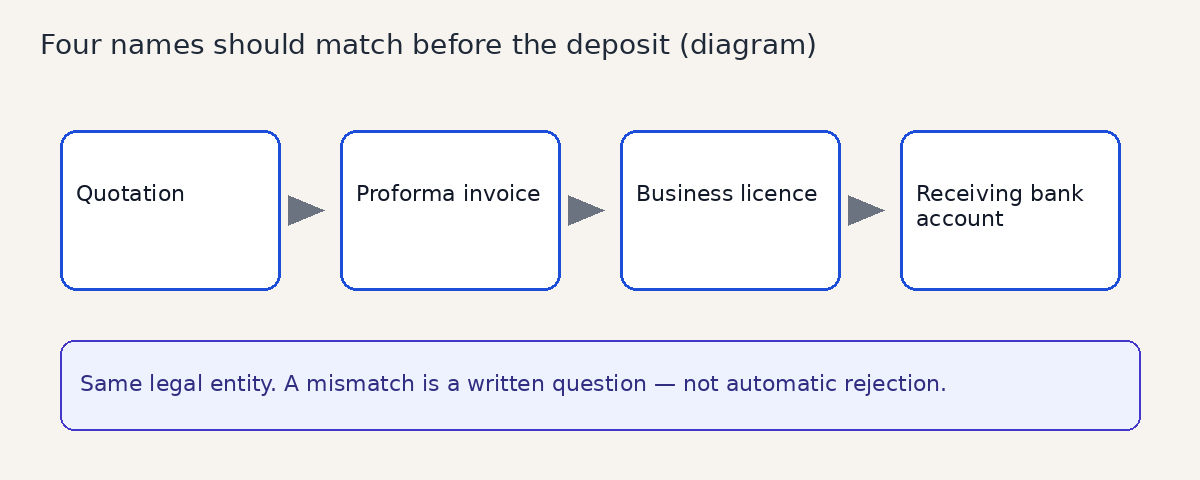
Start with names. The company that quotes you, the company on the proforma invoice, the company on the business license, and the account that receives the deposit should be the same legal entity. When they are not, ask why in writing and keep the answer.
A Chinese business license shows the registered name, address, legal representative, status, and business scope. Check the first two against the quote. Scope can be broad and often omits your exact product, so a missing product word is a question, not a verdict.
Bank details deserve their own check:
- An account in a personal name, when the contract is with a company, is a known risk. So is an account belonging to an unrelated third party.
- A Hong Kong or offshore account is common for exporters and is not fraud by itself. Ask which entity invoices, which entity receives, and whose name appears as shipper on the bill of lading.
- If bank details change after signing, call a number you already had. Never confirm through the email that sent the change. Payment-diversion fraud usually arrives as a calm, well-formatted email.
Ask who holds the export registration and whose name will appear as shipper. If the answer keeps changing, that is information about the supplier, not a paperwork detail.
Visit the site, then look at what leaves it
An audit should stand at the address on the license, not at an office that promises a factory “twenty minutes away.” At the site, the useful observations are boring: the gate sign, the production floor, raw material and work in progress, machine nameplates, and whether the people on the line are making your category or something else entirely.
One building can hold several unrelated tenants. That is normal in China. What matters is which lines are running your order and who controls them.
Then ask which steps leave the building. Plating, dyeing, printing, embroidery, heat treatment, mold making, PCB assembly, and final packing are often subcontracted. That is not automatically bad. Unnamed subcontracting is, because your deposit then funds a process you cannot inspect later.
The same goes for tooling. If your mold sits at another shop, ask who owns it, who can move it, and what happens to it if the relationship ends. A deposit that pays for tooling in someone else’s building is hard to recover.
What the capacity number leaves out
Suppliers quote capacity in units per month. Ask a narrower question: how many lines can run this product, how many shifts, and what is the realistic daily output with the current workforce?
Then compare that with the promised lead time and the orders already on the floor. A factory promising 25 days on a product it makes twice a year is describing a calendar that does not exist yet.
Evidence worth asking for:
- A production schedule for the coming weeks, with customer names removed.
- The material lead time for your main component, and whether it is in stock or on order.
- The name of the line or workshop that will run your order.
- What happens to your date during that factory’s peak season.
A sample proves a sample
The sample on your desk was probably made by the best worker on the cleanest line, possibly in a sample room. That is how sample rooms work.
Ask where the sample was made, with which material batch, and whether the production line has made this product before. If the answer is “same factory, same materials,” write it down and attach the material specification. If the sample came from a market stall or a trading office, the audit should say so before you wire money.
Keep a signed golden sample with the factory and a duplicate with you. Record the details that drift: material grade, color, weight, hardness, dimensions, packaging. A later pre-shipment inspection can only compare production to the sample you both agreed on.
What a QC process looks like from the inside
You are not looking for a quality manual. Small factories often run good control without one.
Look for four habits: incoming material checks, first-article approval, in-process checks, and a sign-off before cartons are sealed. Then ask what happens to a rejected lot. If every answer is “we check everything,” ask to see the last three defect records. Missing records are a finding.
Put the deposit behind evidence
The payment schedule is part of the audit, not a separate negotiation. Whatever percentage you agree, tie later payments to things you can see: audit findings resolved, sample approved, material purchased, production started, PSI passed.
A smaller first payment on a trial order is usually worth more than a large discount on a big one. A supplier who will only accept a large upfront deposit from a new buyer with no site visit is telling you something.
For larger orders, escrow, trade assurance, or a letter of credit can reduce exposure, but read what the provider actually covers. Quality disputes are often handled differently from non-delivery. A deposit without a written specification, tolerance, lead time, and remedy clause is hard to enforce later, whatever the payment method.
The three checkpoints are not interchangeable
| Question | Deposit-stage factory audit | Pre-shipment inspection | Loading supervision |
|---|---|---|---|
| What it answers | Who you are paying, what the site can make, how it controls quality | Whether finished goods match the approved sample and spec | What crossed the container door, under which seal |
| Timing | Before the first deposit, or before scaling an order | When production is finished and mostly packed | At dispatch, before the doors close |
| What is examined | Entity and site match, equipment, capacity, subcontracting, QC habits | AQL sample of units, labels, packaging, carton condition | Carton count, container condition, seal number and record |
| Output | Photo-backed findings and a risk recommendation | Pass, fail, or hold on the lot | Loading report and chain-of-custody record |
| What it cannot tell you | Product compliance, lab results, future performance | Whether the factory can repeat the result next season | Whether the goods inside match the packing list |
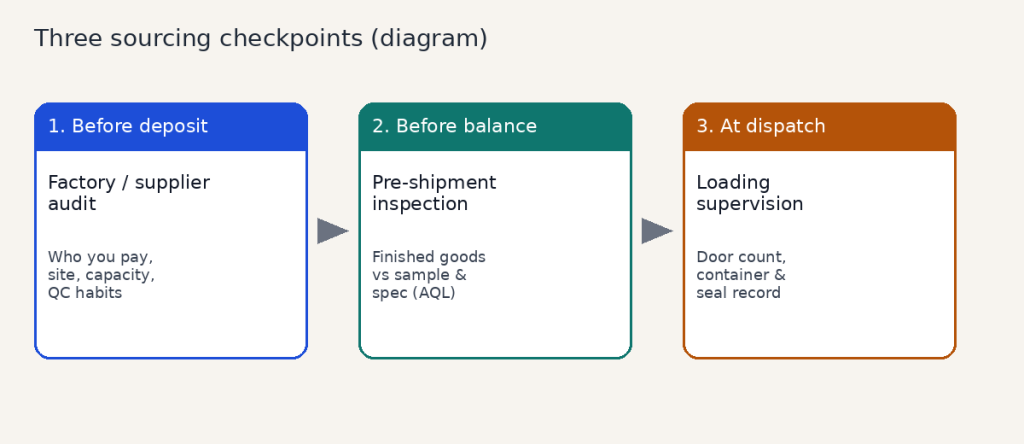
A common sequence for a new supplier: audit, trial order, PSI before the balance, then loading supervision on the first container. Each stage answers a different question. Skipping the first one and buying the other two is a familiar way to inspect goods made by the wrong supplier. The sampling mechanics behind PSI are on the AQL sampling tables page.
What the audit will not cover
An audit is a site and process review. It is not a lab test, a certification, or a social compliance audit. It will not tell you whether your product meets CE, FCC, CPC, or destination-market labeling rules, and it will not tell you whether the supplier owns the IP in the product you are buying.
If those questions matter, book them separately or ask the provider what the scope includes.
When it is reasonable to skip
Repeat orders from a supplier you have used for two years may not need a fresh audit. Neither does a small deposit on a simple product you have already inspected, especially if you have stood on the line yourself.
The audit earns its cost when the supplier is new, the category is new, the first order is large, the price is far below other quotes, or the entity names do not line up. Refusal to allow a site visit, or a sudden insistence on paying today, belongs on the same list.
If the open question is about FBA labels, polybags, or carton packing rather than the supplier, that belongs in Amazon FBA inspection in China, not in a factory audit.
Run it without stalling the order
Send the supplier’s full name in English and Chinese, the production address, a contact who can open the gate, the product, order size, and target deposit date. If the date is already set, say so; it changes how the visit is scheduled.
Ask whether the visit is announced. A staged visit can still be useful, but an unannounced one sees the factory on a normal Tuesday. Ask what the report includes and when it arrives. Photo-backed findings you can forward to the supplier beat a badge or a score.
Then make the decision the report is for: approve, run a trial, require corrective action before the deposit, or walk away. The audit does not make that call. It gives you something firmer than a video to make it on.
FAQ
Is a factory audit the same as a supplier visit? A visit is a look. An audit has a booked scope, evidence, and a written conclusion you can act on.
Can I audit after paying the deposit? Yes, but your bargaining position is weaker. The report still tells you whether to continue, renegotiate, or stop before the balance payment.
Does an audit replace PSI? They cover different jobs. The audit reviews the supplier and the site; PSI reviews the finished goods on a specific order. You still need both when the order is new or large.
Booking the check
Send the supplier name, address, product category, order size, and deposit date. QIS confirms scope and timing before the visit is scheduled. Book a factory audit or compare stages on China inspection services.