
The PDF lands with FAIL in the subject line. The container is booked, the balance payment is due, and the factory wants an answer by tonight. Before you reply, remember what the report actually is: counts from a sample, measured against limits you agreed. So the first job is to find which numbers crossed the line and by how much.
Read the report before you answer anyone
| Field | What to check |
|---|---|
| Quantity finished and packed | If the lot was inspected before packing, label and carton findings are missing |
| Sample size | Matches the plan for your lot size, not a reduced pull |
| AQL level per class | Critical, major and minor at the levels you agreed, not a factory default |
| Defects found vs accept/reject numbers | Which class failed, how far over, and whether counts are sample or lot |
| Photos | The defect, the unit and something for scale in one frame |
| Packing, labels, barcodes | Carton marks match the packing list; labels scanned, not just eyeballed |
The AQL line is where most people misread. Each defect class has an accept number and a reject number. Say majors are set at accept 3, reject 4 (an example, not a recommendation): three majors in the sample passes that class, four fails it. Critical defects are usually zero tolerance. The AQL sampling tables show how sample size follows lot size.
One unit over the reject number and twenty over both print as FAIL, but they call for different conversations with the factory.
Then split product faults from paperwork faults. A missing origin mark or a crooked carton label is a sticker and a re-tape. A short moulding or a seam that opens under load is not. If the lot is still partly unpacked, say so early, because that keeps sorting on the table.
Four ways forward
| Option | Fits when | Time cost | What you keep on file |
|---|---|---|---|
| Rework, then re-inspect | Fault is repeatable and fixable in place | One rework cycle plus a visit | Rework instruction, completion date, second report |
| Sort 100%, then re-inspect | Fault is visible unit by unit | Sorting labour plus a visit | Screened cartons marked, decision on rejects |
| Hold and negotiate | Ship date can move, or the defect is cosmetic | Storage, maybe a rolled booking | Agreed quantity, revised date or amount, in writing |
| Accept as-is, written down | Defect is inside what your buyer will take | None now | Signed concession note filed with the report |
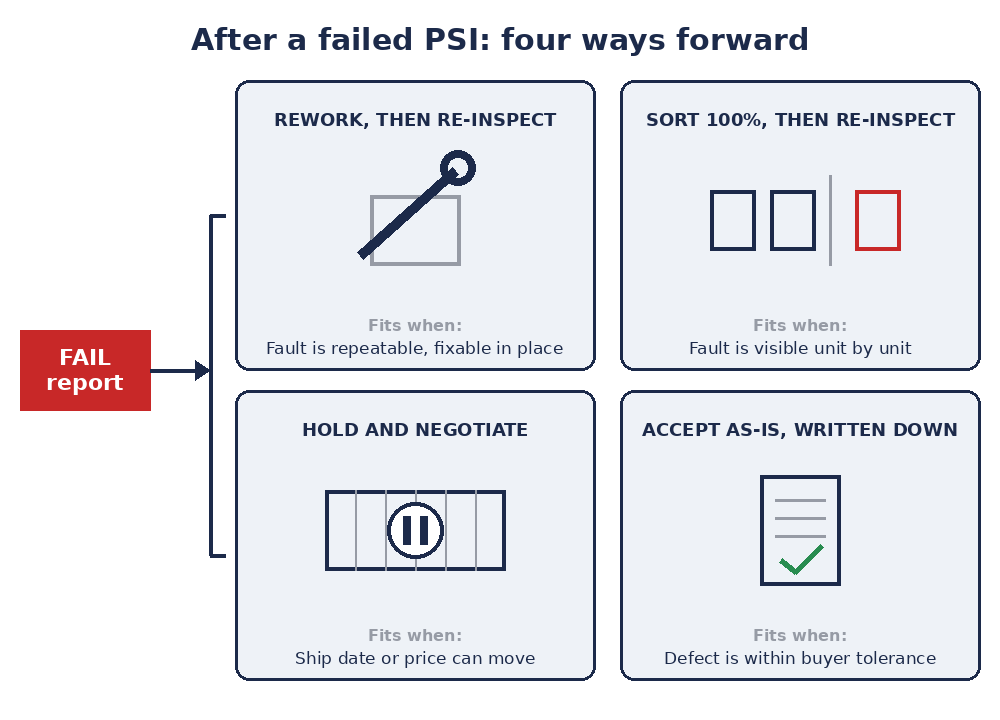
Diagram, not a photo. Which exit you take depends on how far over the limit the lot sits.
Rework needs an instruction the factory can follow and a date. On the second visit, check the reworked units in full and pull a fresh sample from the rest. If you only sample the whole lot again, repaired units get lost in the average.
Sorting classifies; it fixes nothing. It suits faults you can see one unit at a time: a scratch, a missing insert, a label upside down. Ask the factory to mark screened cartons, or the inspector can’t tell sorted stock from unsorted. Decide what happens to the rejects, too. Scrapped is cleaner than “set aside”, which has a way of turning up in the next shipment.
Hold and negotiate works when the calendar has slack. Argue from the report: affected quantity first, then a price adjustment on those units, a split shipment, or a delay with the factory covering storage.
Accept as-is is a fair call when the defect disappears once the unit is installed, or when a delay hurts more than the flaw. Write a short concession note naming the defect, the quantity and why you accepted it, and file it with the PO. Otherwise the next run repeats the fault and nobody remembers it was approved once.
What the second visit should cover
A re-inspection is a new visit with a new report; the first one isn’t amended. Scope it to the reworked or sorted units in full, a fresh AQL sample from the remainder, and packing and labels again if they failed. Book it when the factory gives a completion date, and ask them to keep cartons unstrapped. Sealed stock can only be judged from the outside.
If you keep seeing problems only at the end of the run, move the check earlier. A during-production check catches the same drift while a machine setting can still change.
Who pays
The usual rule: whoever caused the deviation pays to correct it. Units that miss the signed sample or written spec sit with the supplier. If you changed the spec mid-run, or the PO said nothing about tolerance, expect to split it. Terms worth writing into the next PO:
- Defect definitions per class for your product, with the AQL level behind each
- A signed, dated approved sample as the reference
- Who pays for rework, sorting and the second visit after a fail
- Balance payment tied to a passed inspection, not a promised ship date
- Label and packaging spec as an annex, artwork attached
- A shipping window with room for one rework cycle
The FBA layer
On Amazon FBA orders, plenty of fails have nothing to do with the product itself: an FNSKU that won’t scan or covers the original barcode, a polybag without a suffocation warning, cartons with the wrong unit count or missing labels. These are cheap to fix at the factory. That’s why Amazon FBA inspection in China covers labels and cartons alongside workmanship. A clean label check is evidence about your goods; Amazon’s own receiving process still decides what happens at the dock.
If you choose rework, put label and carton faults in the same instruction, or the second visit finds the same cartons with the same gaps.
Before you reply to the factory
- [ ] Sample size and code letter match the lot size
- [ ] Accept/reject read per class, not just the overall verdict
- [ ] Failing class identified, with the count over the reject number
- [ ] Counts confirmed as sample or lot counts
- [ ] Photos show defect, unit and scale
- [ ] Lot still at the factory and open enough to sort
- [ ] Label and carton faults listed separately
- [ ] Ship date and cut-off checked
- [ ] Supplier’s written proposal in hand: quantity, method, date
- [ ] Decision and reason written on the report
Report on your desk now?
Send us the failed report with the PO and approved sample. QIS will go through the fields that matter for your lot, tell you what a second visit should cover, and check the reworked or sorted goods before they’re packed again. If you already know you want another look, book a re-inspection and attach the report in the notes. Our pre-shipment inspection page lists what the first visit checks, so you can see what the second will re-check.