
Put the polybag warning on the pre-shipment checklist
Two shipments can carry the same packing list and still behave differently at a fulfillment center. The difference is sometimes a block of small print on a plastic bag.
Buyers watch the product. The bag often gets treated as packing material. The marketplace treats that bag as part of the sellable unit. When a bagged item needs a suffocation warning and the bags arrive without one, the goods are not ready to receive. The fix then lands at the receiving dock, on the seller account, or in a customer’s hands.
The cheap place to catch it is at the factory, on the visit that already opens cartons and counts units. This piece covers what belongs on that checklist, where misses usually start, and where the job stops before container loading supervision takes over.
What the bag rules actually ask for
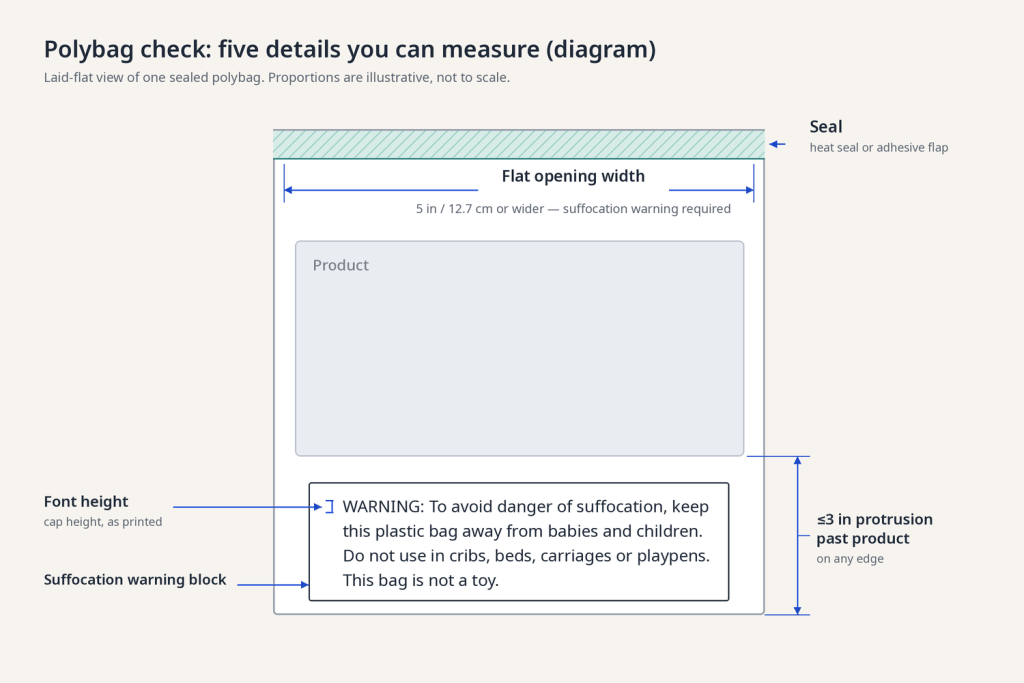
Opening size usually decides whether a warning is required at all. Public summaries of Amazon’s bagging guidance point to bags whose opening measures more than 5 inches (about 12.7 cm) when the bag lies flat. Under that line the warning is often not the issue. Over it, the bag needs wording that names the suffocation risk and tells the reader to keep it away from children and out of cribs and playpens. Confirm the threshold on the live Seller Central / help page for your marketplace before you ship.
Film and shape come next. The same public summaries commonly cite poly bags at least 1.5 mil thick (roughly 38 microns), sealed with an adhesive strip or tape, with the bag extending no more than 3 inches past the product. The FNSKU still has to scan through the film, not sit in a fold or under a second layer. Write those numbers into the purchase order once you have confirmed them on the live help page for your marketplace.
Font size is where suppliers and buyers argue. Third-party prep guides say minimum type scales with opening width, so a 6-inch bag and a 24-inch bag do not share one point size; cited bands often run from about 14 point up to about 28 point, and those bands get revised. Do not treat a blog table as law. Put the confirmed height in the PO so nobody invents it at the packing table.
The US federal standard at 16 CFR Part 1700 is widely cited as the origin of the five-inch threshold for plastic bags used as packaging. Its scope and exemptions belong with a compliance adviser, not with this checklist.
The specification the factory never saw
A supplier cannot meet a rule that exists only in your head.
What the packing floor needs is one page: a photo of the approved bag, the warning text word for word in the language the marketplace expects, the minimum font height, the film thickness with its unit, the seal type, where the warning sits relative to the FNSKU, whether inner bags carry their own warning, and the finished packed dimensions. Put a ruler in the photo so bag size is not a guess.
Language deserves its own line. English is the usual assumption for the US marketplace and does not automatically satisfy a marketplace that expects another language; a bilingual market may need two. Let the buyer name the language, then have the inspector check the bag against that instruction rather than the printer’s file.
What an inspector can actually verify
Most of these checks take a ruler, a gauge, and the approved sample.
| # | Check | What the inspector does | How it fails |
|---|---|---|---|
| 1 | Warning present | Reads the printed block on every bagged SKU in the sample | Bag stock printed before the warning was added |
| 2 | Opening measured | Measures the flat opening at its widest point | Bag resized for a new product; artwork not updated |
| 3 | Font height | Measures the type against the buyer’s spec | Artwork scaled down to fit a smaller bag |
| 4 | Wording and language | Compares word for word with the approved file | Partial translation; the crib and playpen line dropped |
| 5 | Film thickness | Reads a micrometer against the specified mil figure | Purchasing substitutes a thinner film |
| 6 | Seal | Pulls the seam; checks the tape spans the full width | Open end taped by hand, gaps at the corners |
| 7 | Protrusion and fit | Measures how far the bag runs past the unit | Bag folds over the label |
| 8 | Barcode | Scans the FNSKU through the bag at arm’s length | Label on the bag rather than the unit, or under a fold |
| 9 | Inner bags and sets | Checks each inner bag of a multi-pack | Two units in one bag, inner bags bare |
| 10 | Retail packaging | Opens a retail-ready unit: box, print, inserts, seals, scuffs | Crushed corner from carton stacking, security sticker lifting |
Row 10 matters as much as the bag: a perfect polybag can still reach a customer inside a dented box.
Where the miss usually comes from
Most bag problems start earlier than the packing line.
Artwork is approved once, for the first SKU. The next SKU copies the same bag file onto a smaller bag and the type shrinks with it. Purchasing finds a cheaper film, and the warning stays on the old stock until it runs out. A sticker replaces printing because it is faster, then peels off the seal or lands on a panel the customer never reads. A bundle goes into one outer bag, and the inner bags inside it carry nothing.
None of that shows in a product photo or a factory video. It shows when someone holds the bag, measures the opening, and reads the print.
What it costs at the other end
Fulfillment centers do not renegotiate at the dock. A unit that arrives unprepared can be treated as needing prep: relabelling or rebagging, a prep charge on the account, a delay before the inventory is sellable. Some shipments get refused or returned. Treatment and fee schedules change by marketplace and by year, so read the current prep policy for the country you ship to rather than quoting an old blog number.
The slower cost lands on the listing. Packaging complaints sit in reviews next to the product rating, and a photo of a torn bag or a crushed box often persuades a shopper faster than a long feature list.
Sampling: a packaging defect is still a defect
AQL sampling counts defects against an agreed limit. Packaging items belong on the same list as a scratch or a loose screw. Classification matters: a missing suffocation warning on a covered SKU is usually treated as critical, with zero allowed in the sample, while a scuff on a retail box might be major or minor. That call is the buyer’s, written into the booking.
The AQL sampling tables explain how sample size and accept/reject numbers are set. The inspector still needs to record how many units are affected. Three bare bags in one carton and a full run printed wrong lead to different decisions, and the report should let you tell them apart.
Who checks what, and where it stops
These three visits all happen in China and get mixed up. They answer different questions.
| Factory audit before deposit | Pre-shipment inspection with FBA checks | Container loading supervision | |
|---|---|---|---|
| Question | Who you are paying, and whether the site can make this product | Do the finished units and packaging match the approved spec | What went into the container, under which seal |
| Timing | Before the first deposit, or before scaling | Production finished and mostly packed | At dispatch, before the doors close |
| What it can see | Entity and site match, equipment, capacity, subcontracting, QC habits | AQL sample of units, FNSKU, polybag warning, retail pack, carton marks | Carton count, carton condition, container condition, seal number |
| What it cannot see | The packaging print on your actual run | Whether the next run repeats the result | What is inside a sealed bag |
| Output | Photo-backed findings and a risk recommendation | Pass, fail or hold on the lot | A loading record and chain of custody |
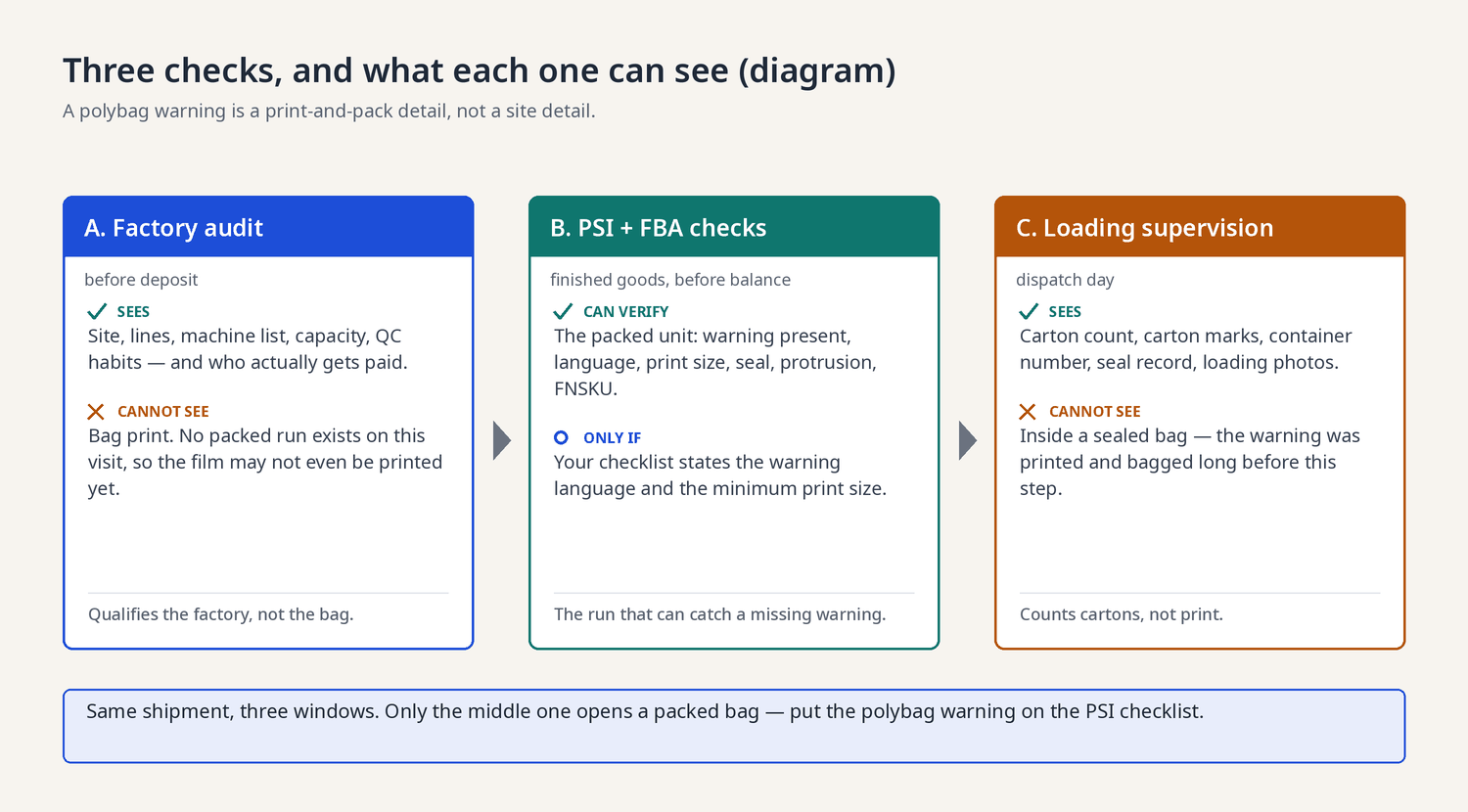
The split matters for this topic. A factory audit tells you whether the supplier has a packing process and whether the bag artwork exists. It cannot tell you that the bags in your cartons carry the right warning at the right size, because those bags were printed after the visit. Loading supervision sees cartons and a container door; the bag inside was sealed days earlier. The polybag check belongs to the pre-shipment inspection, while cartons are still open and a reprint is still possible.
Worth doing on a first order, and again after any change in bag supplier, SKU size, marketplace, or reprint. When the error is systematic, every carton repeats it.
A sequence that survives contact with a factory
Approve a physical bag rather than a PDF. Keep one signed bag with the factory and one with you, and write the approval date on both.
Send the one-page spec with the booking: purchase order, SKU list, product photos, FBA and carton label files, and the packaging page. A checklist nobody sent cannot be applied.
Check before cartons are sealed. A warning added after inspection is not a fix you can verify, so a reprint needs a second look. Keep loading for carton count, carton condition, container inspection, and the seal record.
If the open question is the supplier, start earlier at the factory audit stage. If it is sampling and defect grading on packed units, Amazon FBA inspection in China covers packaging and warnings in the same visit as labels and workmanship.
FAQ
Our product is small. Do we still need a warning? The threshold is measured on the bag opening. A small item in a wide bag still crosses it.
Can we use a sticker instead of printing on the bag? Some sellers do. Whether it passes depends on the current help-page rule and on whether the sticker stays legible and attached. Printed film leaves less to argue about.
The units are retail-ready boxes with no polybag. Does any of this apply? The bag rules may not, and the retail pack still needs its own check: seals, inserts, print, crush damage from carton stacking. The fulfillment center can also decide a unit needs bagging, which brings a prep charge.
Can the factory add the warning after the inspection? It can, and then you have unverified bags. Inspect before sealing, and re-inspect after a reprint.
Booking the check
Send the purchase order, the SKU list, the packaging specification page, and the FBA and carton label files when you book. QIS confirms scope and timing, then inspects against your checklist with photo evidence and a pass, fail or hold result.
Book a pre-shipment inspection or compare stages on China inspection services.