
Measure each outer carton's length, width and height in centimetres, and its gross weight on a calibrated scale, after the cartons are sealed and before they are palletised. Write the readings against the carton ID, photograph the tape against the edge and the scale display, then compare them with the packing list and your Amazon listing. Carriers and fulfilment centres price and route on what they measure. A carton one size band larger than your documents say, or heavier than the receiving limit, costs time and money after the goods have left China. Measuring at the factory takes minutes; arguing with a warehouse weeks later usually does not win.
What the shipment is judged on
Two numbers travel with the cartons: the space they take up and the weight they register. Carriers and fulfilment centres compare the two and bill on the larger one under the dimensional-weight method. The divisor, size tiers, inbound programme rules and fee amounts change by marketplace, programme and year. Read the current figures in your own Seller Central account. Do not rely on any article for dollar amounts or rate tables, including this one.
A carton with soft sides that bulges past its nominal footprint can cross into a larger size band. A carton packed heavier than a published limit can be flagged at receiving, opened for adjustment, or returned at your cost. Neither shows up on a packing list that only records what was intended.
Your listing carries unit dimensions and unit weight for the product-level side of the calculation. Carton-level numbers sit above that: units per carton, carton gross weight, and the space the carton occupies. Wrong carton numbers push the per-unit maths off as well.
When to measure
Measure after the cartons are sealed and before they go onto a pallet. Loose cartons can be squared up on a flat surface. Once strapped and stacked, you are measuring a pallet corner and guessing.
Build three moments into the run:
- At pre-shipment inspection, on the finished, packed lot, so the numbers belong to goods that already passed the sample.
- Before loading, if the lot was packed after inspection, so the pallet plan and container space estimate use real figures.
- On any carton that was re-taped, re-packed or re-labelled after inspection, because its contents changed and its weight may have too.
Sampling is a judgement call. Measure every carton when dimensions vary, when the SKU mix is complex, or when the board changed mid-run. Otherwise cover both ends and the middle of the run, and every SKU and carton size you ship. Cartons from a second board lot can differ by a few millimetres in each direction; across a pallet, that is a different container plan.
The fields to record
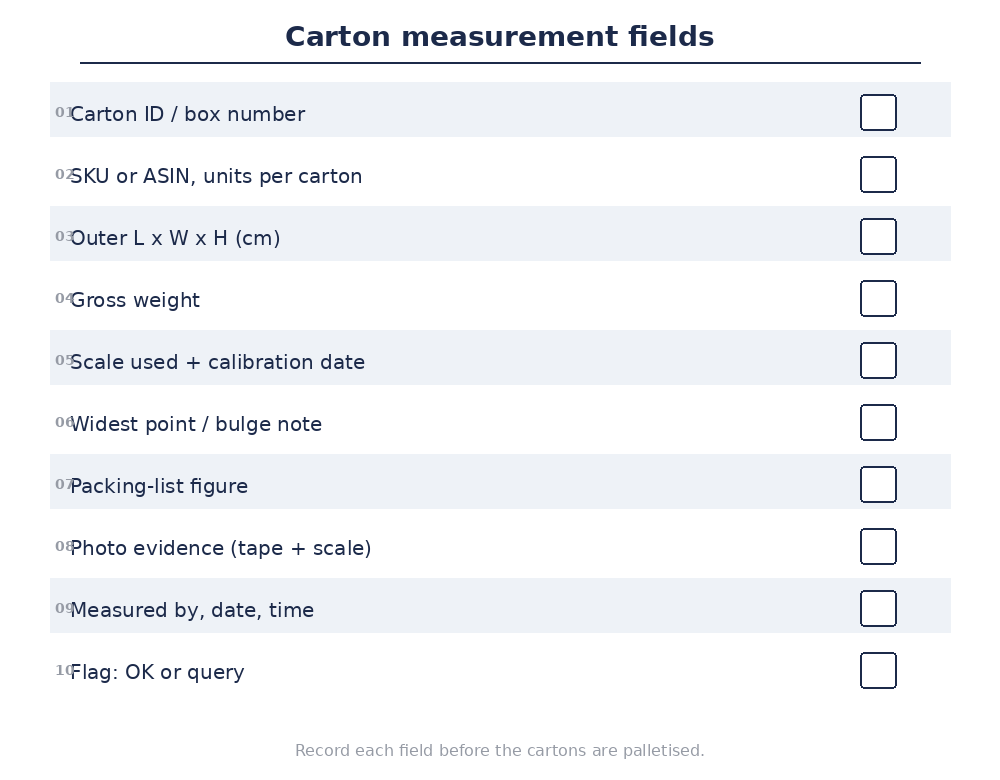
One sheet per shipment, one row per carton or carton group. These are the fields worth arguing from later.
| Field | What to write | Why it matters later |
|---|---|---|
| Carton ID / box number | The number as printed on the carton | Ties the measurement to a physical box in a photo |
| SKU or ASIN, units per carton | Exactly as packed, not as ordered | Carton weight only reconciles if the unit count is right |
| Outer length, width, height | Measured over the sealed carton, flat against the faces, to the nearest 0.5 cm | Feeds size tier and pallet/container planning |
| Unit stated on the record | cm only; no mixed units in one column | Stops a 40 cm carton being read as 40 inches |
| Gross weight | Carton plus product plus packaging, on a scale rated above the expected load | This is the number a carrier reweighs |
| Scale used and calibration date | Make/model or asset number, date last checked | Makes the reading defensible in a dispute |
| Net or tare, if recorded | Packaging weight or a stated tare | Lets you compare with the listing's unit weight |
| Widest point noted | Any bulge, strap compression or bowed lid, with the face affected | Explains why a carton measures over its nominal size |
| Packing list figure | The dimensions and weight the factory declared | The comparison is the point of the exercise |
| Photo evidence | Tape against the carton edge, scale display, carton ID legible | A number without a photo is a claim |
| Measured by, date, time | Name and timestamp | PSI and loading reports should agree on who recorded what |
| Flag | Within expectation, or query raised | Gives the next person an action, not a data dump |
Convert once, at the end, and keep both figures side by side if your carrier or marketplace works in pounds and inches. Rounding drift between two conversions is a common source of small, annoying disputes.
Reconcile before you approve the booking
The measurement sheet only helps if you compare it. Line it up against three references.
The packing list. Carton count, units per carton, declared gross weight and declared carton size. Small decimal differences are normal; large gaps are worth a question before booking.
The listing. Unit dimensions and unit weight, as they appear on the product page and in Seller Central. Multiply the unit weight by the units per carton, add packaging, and see how close you land to the measured gross weight. A wide gap usually means a data-entry error on one side, or a packaging change nobody passed on.
The forwarder's booking. Chargeable weight, carton count and total volume. If your measured gross weight and theirs diverge, find out where the second weighing happened and on what scale.
| Symptom | Likely cause | Move |
|---|---|---|
| Carton measures over the declared size on two faces | Board substitution, over-packing, or a bulge at the seam | Re-measure a second carton, then correct the record before booking |
| Gross weight well below units × unit weight | Fewer units packed than declared, or a lighter unit | Open one carton and count |
| Gross weight well above | Extra inserts, manuals, or a heavier component | Check the pack spec; decide whether the listing weight needs correcting |
| Weight changes from carton to carton | Mixed SKU in one carton size, or manual packing | Measure per SKU, not per average |
| Carton near a published weight or size limit | Packing plan sits on the boundary | Confirm the current limit in Seller Central and adjust the pack before loading |
Check current weight and size limits, tier names and fee amounts in Seller Central for your destination marketplace. Any figure quoted in an article is a snapshot of the day it was written.
What skipping it costs you
Three failures repeat often enough to plan around.
Re-billing after re-measurement. A fulfilment centre measures and weighs what arrives. If its figures differ from the ones your shipment was priced on, the difference is adjusted on your account. You can dispute it, but a dispute needs your own record: date, method, scale, photo. Without that, you are asking a warehouse to accept your recollection.
Receiving friction. Cartons over a published limit, cartons that arrive out of square, or pallets built to a height that no longer matches the declared plan can trigger extra handling, relabelling or refusal at the dock. The receiving team applies its own standard; your inspection report does not bind them.
Freight surprises. Forwarders charge on chargeable weight and volume. When carton dimensions on the booking are optimistic, the correction lands at the consolidation warehouse or at the port, usually with a surcharge and no time to renegotiate. A container plan built on under-declared carton volume also leaves the load short of the space you paid for. That is a loading supervision conversation once the doors are open; the fix still starts with accurate carton numbers on the sheet.
The quieter cost: when the packing list, the inspection report and the booking disagree, nobody can tell which document is wrong, so the shipment waits while three people check. A measurement sheet with photos ends that.
A routine that fits inside an inspection day
Ten minutes per carton group, in this order:
- Square the carton up on a flat surface, lid closed and taped
- Measure length, then width, then height, tape flat against the face, to the nearest 0.5 cm
- Note any bulge or compressed edge, and which face it affects
- Weigh the carton on a scale rated above the expected load, carton fully on the platform
- Photograph the tape reading against the carton edge, then the scale display, carton ID visible in at least one frame
- Write the carton ID, the reading and the scale asset number on the sheet
- Compare with the packing list line for that carton group
- Compare the implied unit weight with the listing
- Flag every difference over your agreed tolerance, with the carton IDs affected
- File the sheet with the inspection report and the packing list, named by PO and date
Agree the tolerance with your forwarder and your prep partner before the run, and keep it written down. A tolerance that exists only in a phone call gets renegotiated after the goods arrive.
Where this sits next to the seal checks
Loading supervision covers custody at the door: carton count, condition, container number, seal number, and what was photographed before the doors closed. Measurement covers the numbers on the cartons themselves. The two records answer different questions. If you want the door-side record, the carton and container checks at loading page covers it; this article stays with the tape and the scale.
For Amazon-specific orders, the FBA inspection in China scope already includes label, carton-mark and packing checks alongside workmanship. Ask for carton measurement in the same visit, and the numbers land in the report you will file anyway. If a lot fails for another reason, the rework, re-inspect or hold decision is the next piece to read.
Send the numbers with the booking
If you have a lot packing this month, send the PO, the packing list and any existing measurement sheet. QIS will tell you which fields are missing, what to measure before the cartons are palletised, and how the readings compare with what your documents declare. To put a measurement pass into an inspection visit, book an inspection and add "carton dimensions and gross weight" to the notes so the inspector brings a tape and a scale rated for the load.