
A factory a third of the way through a run is a different place from a factory at 95%. At a third, the line is set, a few hundred units are already in cartons, and the supplier can still change a jig, re-cut a plate or pull a substituted material. At 95%, the same problem turns into a negotiation about who pays for rework and whether the ship date moves.
That gap is why buyers book early: while the line can still change a setting. Leave it until the end and the same finding is mostly a rework bill.
What a mid-run visit actually does
A during-production check — DUPRO, in-line QC, mid-run inspection — happens after the line has started and before the run is finished and packed. The inspector is not judging a finished lot. They are judging a process in motion: whether the units coming off the line right now match the approved sample and the drawing, and whether anything has quietly changed since the order was placed.
The question changes with the timing. A final inspection asks "can I ship this?" A mid-run visit asks "is this run going to be shippable, and what still has room to be corrected?" The during production inspection page covers scope; the rest of this piece is about the calendar decision.
When to book
There is no universal day count. What matters is how much run is left after the visit.
Bookings usually land somewhere between a fifth and two-fifths of the run completed. That is a working habit, not a measured statistic — early enough that real output exists to measure, late enough that the line has found its rhythm and a second shift, if there is one, has touched the product. A check on day one mostly measures a pilot. A check at the end mostly finds problems that are already packed.
Practically, the timing follows the process:
| Production type | Sensible booking point | Why there |
|---|---|---|
| Injection moulding, die casting | After first-article approval, once a few hundred shots have run | Tool wear and short shots appear after the mould settles |
| Cut-and-sew, textile | After the first full bundle is finished and one wash or steam test is done | Shrinkage and seam behaviour show up after finishing, not on flat goods |
| Electronics assembly | After the first full lot clears the functional test station | Solder and firmware faults surface at test, not at assembly |
| Printing and packaging | After the first full print run is dry and cut | Colour and register drift show across the sheet, not on the proof |
| Mixed assembly, long lead time | Two visits: one on the hard component, one before packing | A single visit can miss the part that lands last |
The exact percentage matters less than one rule: leave enough run that a correction reaches the rest of the output. A finding with 200 units still to make is a conversation. The same finding with 20 left is a rework bill.
The four things that usually drift
Mid-run checks earn their keep on drift — the slow gap between what the sample was and what the line is producing now. Four kinds turn up again and again.
| Drift | How it appears | What the inspector measures against |
|---|---|---|
| Tolerance drift | A dimension creeps a few tenths of a millimetre: still "looks fine", no longer inside the drawing | The drawing's tolerance band, measured on units pulled from different points in the run |
| Material substitution | A resin grade, fabric weight, foam density or film thickness changes mid-order | The approved material spec, confirmed by thickness gauge, weight per unit and the supplier's material declaration |
| Dimension and fit drift | Parts made early no longer assemble cleanly with parts made late | Assembled fit on units taken from both ends of the run |
| Colour batch drift | The second batch reads warmer or duller than the first | The approved sample under a stated light source, against the tolerance the buyer wrote into the PO |
Colour is the one buyers underestimate. Two batches can both match a Pantone reference and still sit visibly apart on a shelf, because pigment lots, substrate and cure temperature all move the result. Whether the difference is acceptable is a business decision, which is why the tolerance belongs in the purchase order before the run starts. If the PO is silent, the inspector can show you the difference and little more. AQL sampling tables then set how many units get measured and how a finding is graded.
What waiting for the final inspection costs
A final check earns its place. The trouble starts when it is the only check on the calendar.
| Situation | Found mid-run | Found at final inspection |
|---|---|---|
| Dimension drift | Adjust the setting, re-measure the next units, keep finished stock that is still inside tolerance | Sort the whole lot, rework or scrap, renegotiate the ship date |
| Material substitution | Stop the substitution, confirm remaining stock, quarantine what used the wrong material | Decide whether the lot ships as-is, is reworked or is rejected — with the container already booked |
| Colour batch drift | Blend or re-run the batch while the press is still warm | Split the lot, accept a two-tone shipment, or reprint |
| Artwork or label error | Catch it before the packing line labels the full run | Relabel every carton at the factory or at the fulfilment centre |
Once the run is packed, you are mostly left with sorting, rework, a discount, or a delay. Each of those usually costs more than adjusting the line while it was still running.
Where the mid-run visit sits between the audit and the loading
Buyers mix these up because all of them involve an inspector standing in a factory. They answer different questions at different moments.
| Factory audit | During-production check | Pre-shipment inspection | |
|---|---|---|---|
| Question | Who am I paying, and can this site make this product? | Is the run on spec while there is still run left? | Does the finished, packed lot meet the spec? |
| Timing | Before the deposit, or before scaling | Roughly a fifth to two-fifths through the run | Run finished, packing mostly done |
| What it can see | Entity, equipment, capacity, subcontracting, QC habits | Live output, machine settings, material at the station, first cartons | AQL sample of finished units, packaging, labels, carton marks |
| What it cannot see | Your actual production output | The final packed lot | Whether the next run repeats the result |
| Output | Findings and a risk call on the supplier | Continue, correct, or hold with notes | Pass, fail or hold on the lot |
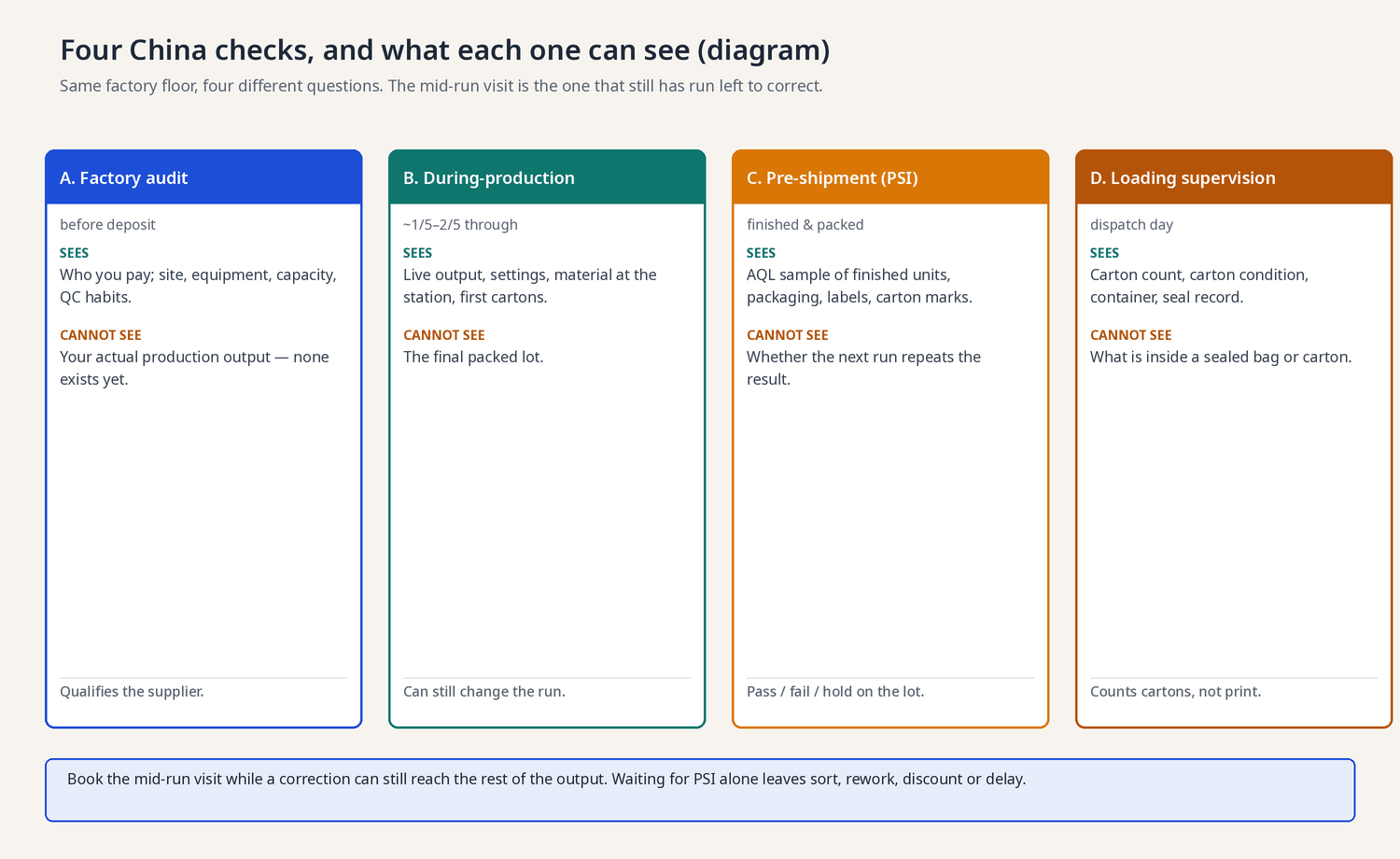
Diagram, not a photo. Four visits, four questions; only the mid-run one still has run left to correct.
The factory audit happens before there is anything to measure. The pre-shipment inspection happens once the room to change has mostly closed. Container loading supervision starts after that, at the door, counting cartons and recording the seal. Each visit answers a different question. The mid-run one is the visit that still has enough of the run left to correct.
For Amazon sellers there is an extra reason to go early. FNSKU labels, polybag warnings, inserts and carton marks get applied in the last stretch of production. A mid-run visit that catches a packaging artwork error saves the relabelling that would otherwise land at the factory or at the fulfilment centre. The Amazon FBA inspection in China scope covers labels and packaging alongside workmanship, and it runs mid-production as well as at the end.
What to send with the booking
An inspector without documents is measuring opinion.
Send the purchase order, approved sample photos with approval dates, the drawing with tolerance bands, the material spec, the colour reference plus the tolerance you will accept, and the packaging and label files. Add the production schedule if you have one: the factory's own percentage-complete figure sets the visit date, and it is worth confirming with a photo of the line rather than trusting a verbal update.
If this is a first run of the SKU, say so. First runs get a different attention pattern from repeat orders, and the inspector will pull units from more points in the run.
What the report should let you decide
A useful mid-run report ends in one of three calls: continue, correct, or hold. Not in adjectives.
For each finding it should say where in the run the affected units were made, how many are affected, whether the deviation sits inside the tolerance you set, and what the factory has already done about it. Photographs of the measurement with the product in frame. "Colour slightly off" is not a finding. "Second batch, 14 units measured, three outside the limit you set, batch still on the line" is.
When to skip it
Not every order needs a mid-run visit, and pretending otherwise wastes an inspection budget.
Runs of a few hundred units leave little to correct. Repeat orders with a stable history and no change of material, line or subcontractor are usually covered by a final check. Simple goods, one process, no colour matching, carry less drift risk.
Book one when something changed: a new factory, a new material supplier, a new mould or print plate, a new colour, a first run of a new SKU, or a buyer deadline that leaves no room for a second attempt. Those are the orders where a mid-run look pays for itself.
FAQ
Can one visit count as both the mid-run check and the final inspection? No. Different point in the run, different question. If the timing collapses, keep the final check and add the mid-run visit only if the run still has time to change.
What happens when the inspector finds a problem? The factory gets a correction window while the line is running, and the next units confirm whether the fix worked. The final inspection still decides the lot.
Do we need a full AQL sample mid-run? Often a smaller pull from several points in the run tells you more than one large sample from the end. The sampling plan is agreed at booking.
Is a video call enough? It hides measurement. A camera cannot tell you whether a wall is 1.8 mm or 2.1 mm thick.
Booking a mid-run check
Send the PO, the approved sample, the drawing with tolerances and the production schedule. QIS confirms the visit date against the factory's percentage complete, inspects live output, and returns a report with photos, measurements and a continue, correct or hold recommendation.
If the run is already on the line and you need a mid-production check — or you want a short call on whether this order needs one before you book — send the order details or request a call. Compare stages on China inspection services.