
A factory audit answers a narrow question well: on the day of the visit, at that address, the site had the building, the machines, the staff, and the paperwork to make your product. It does not tell you which line will run the order weeks later. After work has started, the check is simpler: do the address, the workshop, the equipment, and the name on the shipping documents still match the audit record? If they do, the audit still holds. If they do not, you want that news while the goods are still in the building. That later check is different from the factory audit before you pay a deposit, which is about who you are paying before the order starts.
Why the record and the floor drift apart
Most of the time nothing dramatic happened. A factory that audits well in a quiet month can be running several customers through two lines in a busy one, and the extra order goes wherever there is space. A workshop is reorganised when a new machine arrives. A line that ran your sample in March is now set up for a different product with a different cycle time.
Some processes leave the building as a matter of course, and the factory may not think of that as a change worth flagging. Plating, heat treatment, printing, embroidery, powder coating, injection moulding, or the sewing of a sub-assembly can all be sent out and returned. The factory and supplier audit was probably written about the main site. That arrangement is common. It still means part of the work was done somewhere the auditor never stood.
A trading company may send an auditor to the partner factory that quoted the order, while production later lands at a different partner with an earlier slot. Same sales contact, same email thread, different address on the carton. The same owner may also run a second site nearby and move part of the run to it, or accept more than the first site can finish in the promised window and split the order. Neither is unusual in a peak season. Both change an answer you thought was settled.
None of this means the audit was wasted, or that the factory set out to mislead you. The audit covers a moment. Production covers a period. The work is to connect the two.
Three records, put side by side
The comparison only becomes checkable when the audit record, the production floor, and the shipping paperwork are read against each other. Each one can look fine alone.
| What you compare | The audit record says | The production visit shows | The shipping documents should show |
|---|---|---|---|
| Site | A specific address, gate, and building | Which address is actually running the order, and whether more than one site is involved | Supplier name and address on the invoice, packing list, and carton marks, matching the entity you contracted |
| Workshop and line | Which building, floor, and line the auditor walked | The line now running your order, its machine count, and its layout | Line or batch reference, where the factory uses one on the packing list |
| Key processes | Equipment present for the processes you rely on | The same processes performed on site, or a clear statement of what is outsourced and where | Process or origin statements consistent with where the work happened |
| Capacity | Staff numbers and output at the time of the visit | Whether the order volume fits the line it is on, or is spread across lines and sites | A split across dates or consignments that hints at more than one production point |
| Product | Sample or reference build reviewed at the audit | The unit being built to the approved sample and specification | Item, quantity, and version on the packing list agreeing with what was inspected |
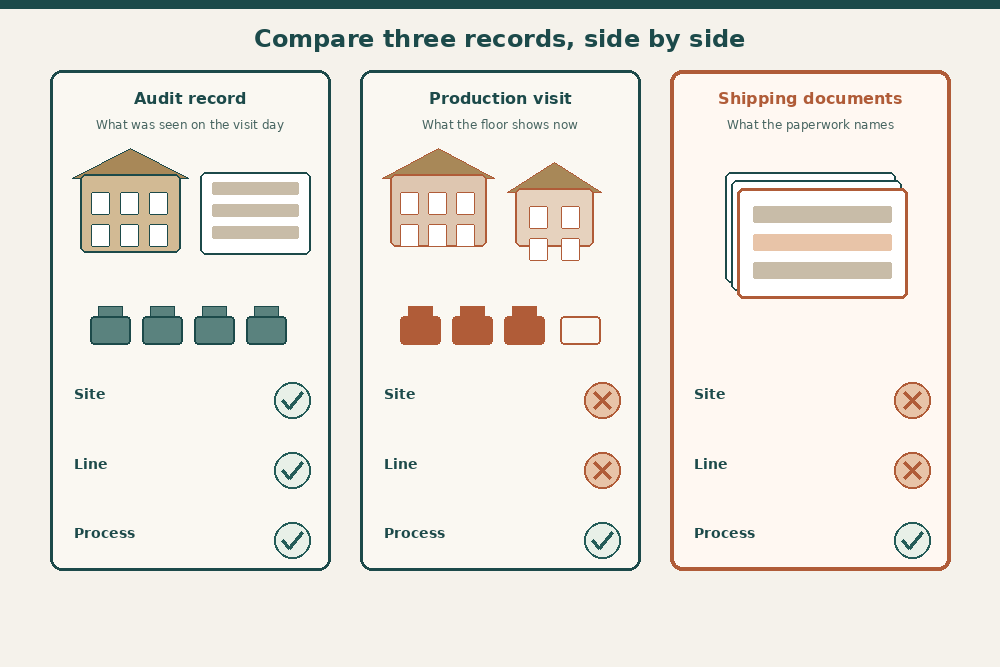
A row that fails on its own is a question, not a verdict. Several rows failing together is the pattern worth acting on.
One limit on how the table gets used: a photograph of a workshop in the audit report proves that workshop existed. It says nothing about which building the cartons will be collected from. Those are separate facts, and they need separate confirmation.
During production: ask, then walk
The first useful question on a production visit is plain: which line is making this order, and where is it? Ask the person who runs the floor rather than the person who handles customers, and ask before the walk, so the answer is on record.
Then go and look at that line. Machine count, layout, the fixtures and gauges in use, the number of stations, the people working them. If the audit report includes a photograph or a description of the line, compare the two on the spot. A line that has gained or lost a large share of its equipment is a different line in practice, even at the same address.
Match the process, not only the finished item. Two sites can assemble the same product by different routes: one welds a joint, another rivets it; one prints a mark in-house, another sends it out. On a production visit the route matters, because the audit reviewed a specific set of capabilities and the quotation was based on them.
Volume is the quieter tell. If the order is large relative to the line’s realistic output and the delivery date has not moved, part of it may be running somewhere else. Ask that directly, without accusation: where is the rest of it, and can we see that site? A during-production inspection is the natural place to raise it, because the order is part-built and the answer can still change the plan. If you are still deciding when to go, the note on when to book a during-production inspection places the visit against the production calendar.
Before shipment: does the paperwork name the same site
By pre-shipment stage, the goods exist and the question shifts from process to identity. The name and address on the invoice, the packing list, the carton marks, and any origin statement should belong to the entity you contracted, at the address the audit covered, or at an address you have since agreed in writing.
This is often where a second site becomes visible. Carton marks printed for one address, a packing list issued by another company, a supplier name on the invoice that does not appear in the audit report: each is a thread to pull. Ask for the production record for the batch, and ask which address the goods will be collected from. A factory that has been straightforward about a split order will answer quickly and consistently. A story that changes between two people on the same visit is information too.
The pre-shipment inspection is also the point to check that the units on the floor came off the line you saw. Work-in-progress left on a line, the same fixtures, the same sub-assemblies in the same trays: these connect the finished carton to a place. When that connection is missing, the inspection can still judge the goods. It should also say plainly that it could not confirm where they were made.
When the two do not match
Hold further approvals until the facts are written down. That means no shipping instruction, no release of the balance, and no loading date that assumes the goods are already cleared.
Ask for a written explanation: which site made the goods, which processes were subcontracted, when the decision was made, and who at the supplier authorised it. Written, because a spoken answer at the gate often changes by the time it reaches the person paying the invoice.
Then decide whether a second site needs its own visit. A subcontracted plating step and a completely different assembly factory are different problems. One may be acceptable with documentation. The other means the capacity, the equipment, and the quality system you audited were never the ones applied to your order.
Adjust the shipping plan to what you now know: an additional inspection at the second site, a re-check of the batch, or a staged release. Loading supervision belongs here when you need to know that the cartons inspected are the cartons shipped.
Where this leaves your contract, your deposit, and your remedies is a question for you and your own adviser. An inspector can document what is on the floor and what the paperwork says. Reading the supply agreement is a different job, and it is not one to improvise from a factory visit.
What to send when you book
An inspection that confirms line consistency needs the reference material before the visit, not during it:
- The audit report or visit minutes, including the address, building, line description, and any photographs of the workshop.
- The supplier’s legal name and the address on your contract or purchase order.
- The production schedule: start date, current stage, expected completion.
- The planned line or workshop, if the factory has already told you. If it has not, that is the first thing to ask.
- Order volume and the number of cartons expected, so the floor can be read against the schedule.
- The name and role of the person who will walk the floor with the inspector, and whether more than one site is involved.
- Any subcontracting the supplier has already disclosed, with the address of that site if it is known.
Send these with the booking and the visit can start with a comparison instead of an introduction. If the audit was done by another provider, the report is still useful; the address and the line description are what the later visit checks against. Ongoing supplier quality control can keep that comparison going across a longer run, after the first production visit.
Confirm the line before the cartons close
Production-line consistency is a small piece of work at the right moment: after the order is running, before the goods are packed, with the audit record open on the table. It takes a visit. Missing it can leave you explaining a shipment that was made somewhere you never agreed to.
If your order is already in production, or about to start, book an inspection and tell us which site the audit covered. We will confirm what can be verified on the floor and what needs a written answer from the supplier first. For the wider service picture, see the services overview. If you would rather describe the situation before booking, contact us and we will tell you what is checkable from where you are.