
A carton can clear FBA receiving with a readable label on every unit and still hold the wrong mix of sizes or colors. Intake scans the label and records a weight. It does not open the box. On a single-SKU order the packer has one thing to pick, so the label and the contents usually agree. On an order with three colors and four sizes, the same packer makes a decision for every unit, from a sheet, often late in a shift. The check that catches the result is physical: open an agreed number of cartons at the factory, lay the units out by variant, and count each row against the packing list before anything is sealed and loaded. That count belongs inside a pre-shipment inspection. It is still early enough to correct the mix before the shipment is received and put away.
What a clean scan actually proves
A unit label has one job: identify one unit and scan at receiving. It does that whether or not the unit sits in the right carton. Put a labeled medium into a carton marked for large, and the scanner is satisfied. The count may be satisfied too. The buyer is not.
The carton label has the same limit. It is generated from the packing plan, so if the plan says eight navy mediums, the label says eight navy mediums. If the plan is already wrong, the two records agree perfectly. That looks like proof at midnight on a dock. It is only consistency.
The problem usually shows up late: at pick-and-pack, when a size that should be in stock cannot be filled, or when a customer opens a parcel and finds the wrong color. Totals hide this well. A shipment of 2,400 units can arrive complete and still be short in one variant and long in another, because the first number most people check is the one that stayed correct.
This is a different failure from a label that will not scan. Unreadable or missing labels have their own causes and their own fix, covered in FNSKU and barcode mistakes that delay receiving. In the cases below, every label scans, and every unit is the SKU printed on it. The box is still wrong.
Four records, compared in a fixed order
Before the first carton is cut open, four records go side by side on the packing table. Each answers a different question, and the order of comparison matters.
| Record | What it tells you | Where it misleads |
|---|---|---|
| Order allocation, variant by variant | The size and color breakdown the purchase order should contain | Says nothing about which carton carries what; a correct total can still be packed badly |
| Packing plan, per carton | The reference for the carton in your hands: carton ID, variant codes, quantities | Plans get edited during packing; confirm you hold the version in use that day |
| Carton marking or shipping label | What the outside of the box claims, including quantity | Generated from the same plan, so it repeats the plan’s mistakes and adds nothing independent |
| The physical contents | Ground truth: what is actually inside | Only visible after the tape is cut |
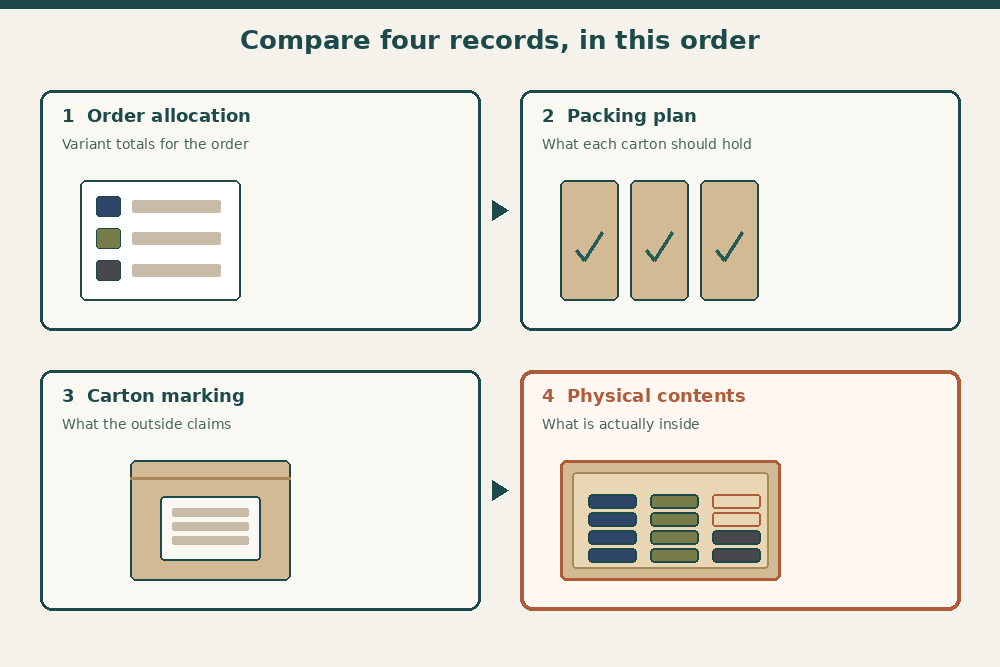
Compare in that order and the failure point shows itself. Plan against label says whether the carton was marked correctly. Label against contents says whether the packer followed the marking. Contents against the order allocation says whether the buyer will get the mix they paid for. Going straight to a count finds the error, but loses where it entered — which is what the factory needs if the same sheet is still in use.
Choosing which cartons to open
Ask for the packing plan before the visit and pick the sample from it, rather than only from the pallet in front of you: early cartons, mid-run cartons, the last cartons packed, and one of every distinct carton type. Mixed cartons need more attention than solid ones. Twenty-four navy mediums can often be judged by looking. Twenty-four units across four sizes have to be counted.
How many cartons get opened follows the sampling plan agreed for the order. The AQL sampling tables commonly used for unit defects can help you spread that sample widely enough that a repeated packing error has a fair chance of landing in front of the inspector. They do not replace a variant-level count, and this article does not recommend a default AQL value. A new supplier, or a mix problem on the last order, is a reason to open more. When you book a pre-shipment inspection, the assortment count is one of the checks inside the visit, alongside the other Amazon FBA inspection items.
Counting by variant, with a worked example
The total is the number that hides a bad mix most often. A carton holding 24 units when the plan says 24 passes a total count even when six of those units belong to the wrong variant. Count in variant rows: every color-size pair gets its own line, counted once from the carton and once from the plan. Units go into stacks of five on a clean surface. A stack of five can be audited. A heap cannot.
The figures below are invented, for illustration only: a three-color, four-size order at 24 units per carton, two of each variant. Only the four failed rows are shown, out of twelve.
| Variant (color / size) | Packing plan says | Counted in carton | Result |
|---|---|---|---|
| Olive / L | 2 | 0 | short 2 |
| Olive / M | 2 | 4 | over 2 |
| Black / XL | 2 | 3 | over 1 |
| Black / L | 2 | 1 | short 1 |
| Carton total | 24 | 24 | total correct, mix wrong |
Read the total line last. It is the only line that looks fine. In a case like this, the carton can also weigh close to a correctly packed one, so nothing at the receiving station has to flag it. Later, one size is missing when it is needed, and another sits unsold.
Weight still earns its place as a filter for which cartons to open first. Where variants differ in weight, a wrong mix often lands outside the expected band — the cross-check described in carton dimension and weight checks. A heavy or light carton is a reason to open and count. The scale narrows the search. It does not do the counting.
Four patterns that repeat
The color swap
Two colors sit next to each other on the packing bench and look similar under factory light: charcoal and black, two navies, a warm grey and a cool grey. Packers pull from adjacent bins, and the mistake stays hard to see until the units are under daylight. Count by the color code on the polybag, then open one bag per color and look at the unit inside. A wrong sticker on a correct unit is a second trap, because every picker downstream will trust the sticker.
The inverted size ratio
A sheet that reads 2-3-4-3 gets packed as even quarters, or the size row is read from the wrong end. The carton holds the right number of units, the label is right, and the ratio is backwards. This shows up when sizes are listed in two languages, when columns shift between carton types, and when a packer has memorized the last order’s ratio.
The tail carton
The end of a run is where leftovers go: extra units from a short-packed carton, a partial polybag, the last of a color that ran long. All of it lands in whichever carton is still open. A tail carton with 19 units inside a 24-unit master carton tapes shut like any other, and it is the one most likely to carry a handwritten correction. Open the last cartons packed as a rule.
The missing insert
Inserts, spare parts, cables, hangtags, and size stickers are often packed at a different station, so they fail on their own schedule. The unit matches, the count matches, and the insert is missing from part of the run. Count it on its own line so a shortfall cannot hide inside a correct unit count.
When the count does not match
The first hour matters more than the argument that follows. Cartons packed from the same sheet are suspect, so mark them and pull them off the pallet before the factory seals anything else. Everything packed from that plan stays unverified until it has been opened.
Write the result in a form the factory can act on: carton ID, variant code, quantity expected, quantity found. A photograph helps when the carton label and the counted units sit in one frame. A pile of garments on its own proves very little.
When the factory reworks the cartons, re-open the corrected one plus at least two others from the same batch, because a wrong sheet repeats. If the error runs through a whole packing batch, the decision moves to the buyer: re-pack and re-inspect, hold the shipment, or ship the sound part and delay the rest. The note on what to do when a pre-shipment inspection fails sets out those options.
If corrected cartons will be sealed the same day, that pallet needs a second look before the container doors close. Loading supervision is the last point at which a mix error is still easy to fix.
What to send when you book
These six items turn a visit into a comparison rather than a guess:
- The variant-level assortment, using your factory’s codes. “2,400 units” is not enough to check anything against.
- The packing plan for the run: carton IDs, per-carton quantities, and the version the factory is actually packing from.
- A photo of a printed carton label, or the label file, so the marking can be read before the inspector arrives.
- The packing schedule: the check has to happen after cartons are packed and before they are sealed and loaded.
- Variant weights, if you have them. They help decide which cartons to open first.
- The site address, the floor contact, and whether packing happens in one hall or several.
If the packing plan is still being edited, say so. That is a reason to book the check later in the run, not to skip it.
Book the count before the tape goes on
If your next order carries more than one size or color, plan the assortment count while the cartons are still open. Send the order allocation and the packing plan with the booking so the visit can be timed to the packing window. Book a pre-shipment inspection with the multi-SKU count included, or contact us first if the plan is not final. For the wider set of FBA checks, see Amazon FBA inspection in China and the services overview.