
A carton that is taped shut and labeled correctly looks finished. It does not tell you the packing is strong enough for the trip. Ocean transit and last-mile handling load a carton in ways a packing table never does: containers stack high for weeks, handlers drop and drag boxes, and a carton that looked fine when it was closed can arrive with a crushed corner and a product loose inside. The parts that usually fail first are the cushioning, the corner protection, the fill in the empty space, and the way the cartons are stacked. Before export, check whether those four things look strong enough for the route, while the goods are still on the factory floor.
Where the damage usually starts
Stacking is the slow one. Cartons near the bottom of a container carry the weight of everything above them for the length of the voyage, and a box designed for a retail shelf does not always have the compression strength for that column. When the board softens in humid air, the column gets weaker.
Corner impact is the fast one. A forklift tine, a pallet corner, or a carton swung into a container wall hits the corner first, and a broken corner is often the first thing a receiver photographs.
Movement inside the box hides until the carton is opened. When the product can shift, every bump in a truck becomes a small impact against the wall, and by the destination the product has been striking its own packaging for weeks. Scuffed units and loose accessories often trace back to a void that was never filled.
This is ordinary wear from a sea leg, a port, and a delivery van. That is why the check belongs before the doors close, rather than after the claim.
What to look at before export
An inspector walking the finished-goods area can read a lot without opening every carton. The table below is a working field checklist: visual and handling observations on a factory floor, not a laboratory test and not a certification that inspected packing will survive the voyage.
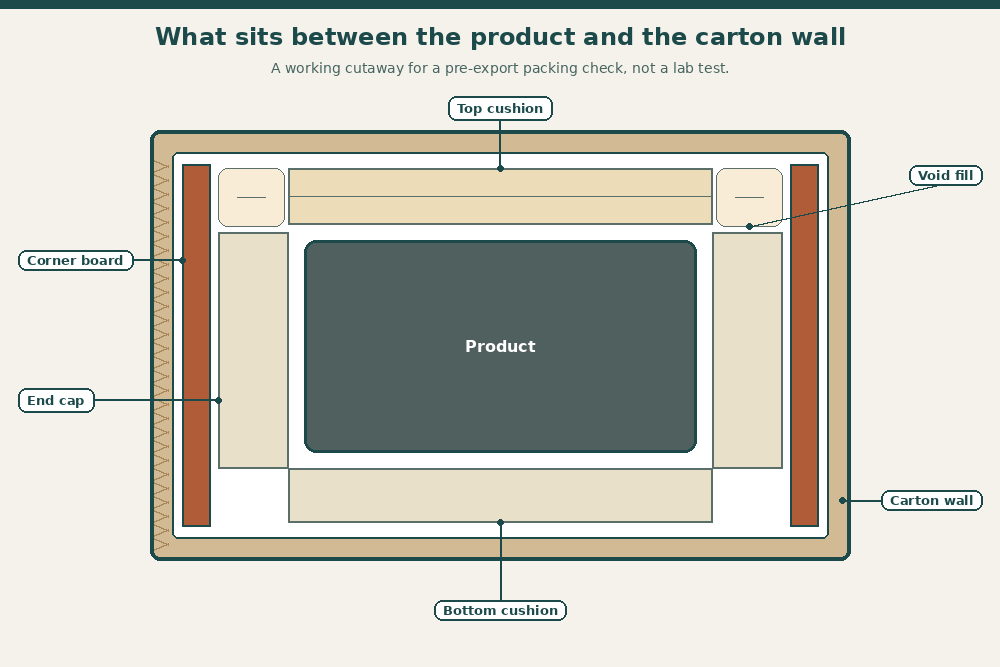
| Structure | What to look at | Why it matters for transit | What goes in the report |
|---|---|---|---|
| Inner packing and cushioning | Cushioning under, above, and around the product; thickness and coverage; fixed in place or free to move; matches the approved method | Thin or displaced cushioning turns vibration and small impacts into a direct load on the product | Photo in position, material noted, whether it stayed where it was put |
| Corner and edge protection | Corner boards or edge protectors; length; how many vertical edges carry them; held on by a strap or loose | Corners take the first contact in handling and carry a share of the stack load | Photo of each protected corner, coverage noted, whether protection stays on when lifted |
| Void fill | Whether empty space is filled, with what, and whether the fill stays put when the carton is tilted | Empty space lets the product build speed and strike the wall; fill that settles leaves the top half open | Fill type, approximate share of the cavity occupied, photo after tilting |
| Stacking and strapping | Stack height in the warehouse, tier alignment, pallet pattern, strap tension, lean | Warehouse stacking is a preview of container stacking; a lean gets worse at sea | Photo from two sides, tier count, strap condition |
| Cartons already in the pile | Creasing, soft panels, split corners, water stains, dents on the top face | Existing marks show where the load has already been too much | Position in the stack, close-up photo, whether the product inside is affected |
One marked carton is a question. The same mark across three cartons is a pattern, and the pattern tells you where the packing is thin.
Inner packing
Cushioning only works where it sits between the product and the wall at the points where the gap is short. Foam end caps on two sides of a heavy product, with nothing on the other two, leave those sides unprotected. That tends to appear when a packing method is copied from a smaller item.
Compare what is in the carton with the approved packing method. Factories under schedule pressure sometimes simplify packing in small ways: a two-piece foam set becomes a folded sheet, a moulded insert becomes a bag of loose pieces, a corner block moves from four corners to two. Each change looks minor at the packing table, and each removes protection from a place that needed it. Ask the supervisor to repack one carton in front of you. Watching the step tells you more than looking at a finished box.
Corner and edge protection
Corner boards earn their place when they are long enough to spread a hit along the edge, and when something holds them against the carton. A short board that slides out of position protects a corner only for the first few minutes of the journey. Count how many vertical edges carry protection: four is a different specification from two, and the difference often shows up as broken corners on one side of the pallet.
Void fill
Fill has to stay where it was put. Loose fill settles under vibration and leaves the upper cavity empty; air pillows can lose pressure slowly; crumpled paper compresses. Tilt the closed carton gently and listen, then open an agreed sample and see where the gaps are. Fill packed tightly enough to bulge the panels is its own problem, because it pushes against the corner seams.
Stacking and strapping
The finished-goods area is a preview of the container. If the bottom cartons are visibly bowed after a week in the warehouse, they will be worse after a longer time at sea. Note the tier count, whether tier corners line up, whether cartons overhang the pallet edge, and whether straps hold the load square. Overhang deserves its own line in the report: the corner past the pallet edge is the one that gets hit first.
Sampling a few cartons by hand
The hand check is simple, and its limits are worth stating. This is a visual and handling assessment on a factory floor, not a drop test, and nothing here is a laboratory procedure or a certification that inspected packing will survive the voyage.
Take cartons from more than one place: the bottom of a stack, the middle, and a pallet packed late in the shift, since late cartons are worth including on purpose. Lift a corner and feel whether the box holds its shape. Press a side panel and see how far it gives. Tilt the closed carton and listen for movement. What you want is evidence of the load the carton has already carried, plus the parts of the packing that are missing. Both go in the report with a photograph and a position note so the factory can find the same carton later.
When the packing looks thin
Do not accept the shipment and hope. Write down what you saw in terms the factory can act on: which structure, which cartons, which pallet, and whether the product inside is already marked. Then ask for a written plan covering what will change, which cartons get repacked, and when the work will be finished. A spoken promise at the loading dock is easy to lose once the truck leaves. Book a second look before the container is closed. That visit can be short, because it only confirms the structures you flagged.
If the goods are already packed and the sailing date is close, the same observations fit into a pre-shipment inspection, which can cover packing and carton condition alongside the product check. On Amazon-bound orders, the carton and packing review sits inside FBA inspection in China work, since FBA receiving adds another round of handling after the sea leg.
Confirm that the cartons you checked are the cartons that ship
A packing check is only useful if the cartons you opened are the ones that get loaded. This is where loading supervision earns its place: the inspector who watched the packing can watch the load, confirm that the pallets on the container floor are the ones already checked, and see that the last rows go in stacked like the rest. Condition at the container door is the last chance to catch damage from warehouse handling, and it is cheaper to learn about it before the doors close. The note on carton and seal checks at container loading covers that later stage, and does not replace the inner-packing check described here.
Carton measurement belongs to a separate check. The FBA carton size and weight note covers that side. Those numbers tell you whether the carton meets a receiving or fee-related requirement. They say nothing about whether the packing inside will hold, which is why both checks are worth doing on one visit when the schedule allows.
What to send with the booking
An inspector can only judge packing against something. Send these with the booking so the visit starts with a comparison rather than an introduction:
- The approved packing method or packing instruction, with photographs of the inner packing if they exist.
- The product specification, naming the fragile, heavy, or sharp parts that need attention.
- The stacking plan or pallet pattern, and the planned loading method if it is already decided.
- The destination and channel, such as an Amazon fulfilment centre or a retail DC, plus the shipping mode, because sea and air load cartons differently.
- The number of cartons, SKUs, and pallets, so the sample can be spread across the run.
- Any packing complaint from a previous shipment, with photographs. A known failure point is the best place to start.
The services overview places this visit among other inspection types, and a short note through contact can point the order to the right visit. Sampling method is on the AQL sampling page.
Check the packing while it can still be changed
Packing strength is cheap to review before the container is sealed and expensive to argue about after the receiving photos arrive. The work is modest: open a few cartons, look at the cushioning and the corners, tilt the box and listen, and read the way the stack is built. That gives you a chance to fix a thin layer of foam while the goods are still in the building.
If your order is packed and waiting for a sailing date, book a pre-shipment visit and say what the cartons are and where they are going. We will confirm what the check can cover on your order and what the factory needs to prepare before we arrive.