
On November 5, 2026, Amazon published its 2027 update to US referral and Fulfillment by Amazon fees. Two changes in that letter reshape how much stock is cheap to hold: from February 1, 2027, the aged inventory surcharge folds into a single age-based monthly storage rate, and the low-inventory-level fee applies only when cover falls below 28 days of supply. Taken together they push sellers toward a narrower band of stock cover — enough to stay clear of the low-inventory fee, short enough that aged-inventory pricing does not start biting. The practical response is smaller POs and more frequent shipments. Each of those orders arrives as its own production run, with its own material lot and its own hours on the line, so the check before a lot ships gets more valuable as the lots get smaller.
What the letter actually says
Amazon’s letter is short and dated, which makes it easy to quote accurately. This is the part that changes a replenishment plan: Update to US Referral and Fulfillment by Amazon fees for 2027.
| Date | What changes | The letter, in short |
|---|---|---|
| Published Nov 5, 2026 | Timing | Most changes take effect January 15, 2027; shared now so sellers have more than two months to plan |
| Jan 15, 2027 | Fulfillment fees | Up $0.19 per unit sold on average, about 0.8% of the average item's selling price; impact varies by product, size and price, and some fees rise while others fall |
| Jan 15, 2027 | FBA fuel and logistics surcharge | Remains unchanged |
| Feb 1, 2027 | Storage utilization surcharge | Eliminated |
| Feb 1, 2027 | Aged inventory surcharge | Removed and combined with monthly storage fees into one age-based rate: flat or lower for inventory that turns in under six months, higher for aged inventory |
| Feb 1, 2027 | Low-inventory-level fee | Assessed today on trailing 30- and 90-day sales; from February 1 it applies only below 28 days of supply, using actual shipments in both the four weeks before and after the assessment date |
The $0.19 and the 0.8% are catalogue averages published in the letter. They are not a quote for your account, and treating them as one leads to the wrong decision about which SKUs to push and which to let run down. The letter names two tools for the account-level view: the Fee Change Comparison dashboard in Profit Analytics, and the Revenue Calculator. It also points to a fuller 2027 fee summary covering small and large standard-size items, items priced above $50, Buy X Get Y promotions, Multichannel Fulfillment and Amazon Warehousing and Distribution. Read those numbers in your own Seller Central rather than in a summary written by someone else, because that is where the per-SKU figures live. On the fuel and logistics surcharge, the letter says only that it remains unchanged and does not restate a percentage, so check the rate that applies to you in your fee preview.
What that does to a replenishment plan
What follows is our reading of the two mechanisms, not a promise Amazon made. Two fee lines now pull on the same decision. Storage priced by age gets expensive once stock passes six months, and the low-inventory fee starts once cover drops under 28 days, measured on shipments either side of the assessment date. A seller who wants to stay clear of both ends keeps most SKUs turning inside six months while holding more than about four weeks of cover, with transit and receiving time allowed for. Where exactly that range sits depends on your sell-through, your lead times and your own fee lines, which is why the dashboard in your account matters more than any rule of thumb in an article.
The shape of the order changes before the shape of the inspection does. A seller who used to place two large POs a year and warehouse the stock now books a smaller run every month or six weeks, and the factory sets up for that seller more often. Each setup restarts the risks that a long run would have absorbed: a new material lot from the same supplier, a different line or shift, a packing crew working from the same instruction at a different pace, and a shorter window between the last unit coming off the line and the cartons going on the water. A fault that a six-month order would have spread across months of sales now arrives in a shipment that represents most of next month’s revenue.
There is a second effect, less obvious and more expensive. Small lots get waved through. The reasoning sounds reasonable at the time — three hundred units hardly justify a visit — and it holds until the same factory ships the defect again in the next small lot, and the one after that, because nobody stopped the line long enough to see it.
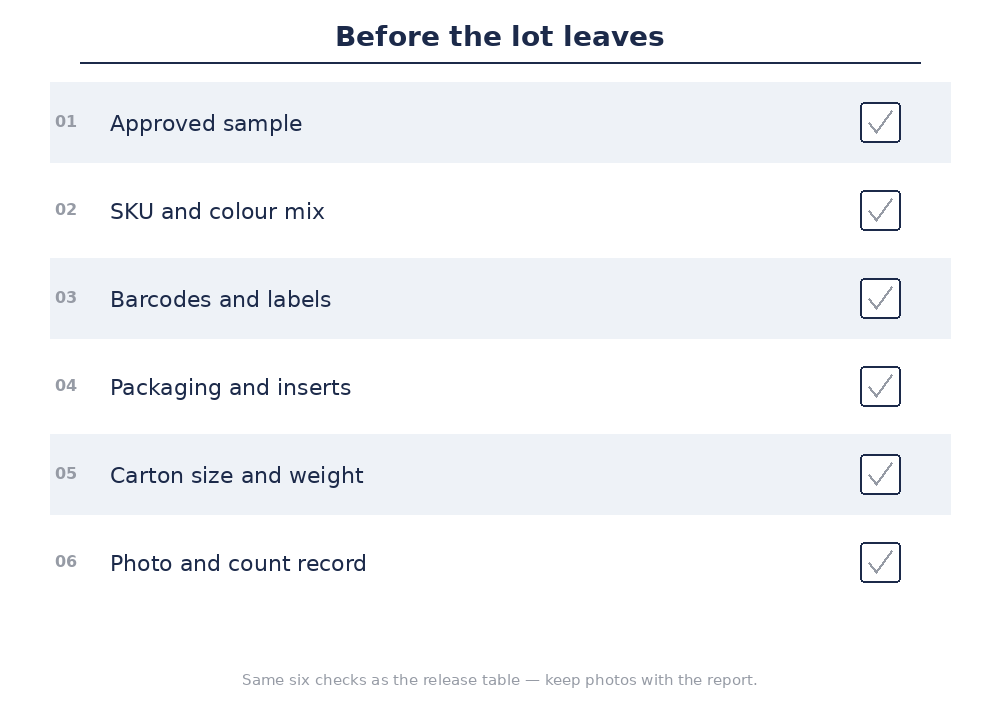
Six things to confirm before a lot leaves
Run this as a release check on the packed lot. It catches the mistakes that are cheapest to fix while the goods are still at the factory; book a full AQL sampling visit when the risk warrants it.
| Check | What a pass looks like | What it costs when skipped |
|---|---|---|
| Against the approved sample | The signed sample is at the factory and the inspector compares production units to it in daylight: colour, material, finish, hardware, print position | A lot that matches the spec sheet and not the sample you approved, selling as a variant of what customers saw |
| SKU, colour and size mix | Count per SKU, colour and size against the packing list and the PO, ratio packs included | Short packs, swapped colours, assorted cartons that receiving has to break down |
| Barcodes and labels | FNSKU scannable at unit and case level, applied flat in the agreed position, clear of seams and curved edges; required warnings and country-of-origin marking present | Relabelling at a prep centre, or a charge for it, and receipts held up by an unreadable code |
| Packaging and inserts | Polybag and its warning, unit carton, manual, inserts, gift packaging as approved, closures that survive transit | A pack that no longer matches the listing photos, and returns that name the packaging |
| Carton dimensions and gross weight | Measured on the sealed carton and recorded against the carton ID | Re-billing after re-measurement, or a size band you did not plan for |
| Photo and count record | Carton count, label photos, closed-carton photos, inspector name and time on the report | No evidence to work from when a count is disputed weeks later |
Carton measurement is the one item on that list with its own method, and it is already written up: how to measure carton size and gross weight before the shipment is booked. Use that article for the tape, the scale and the fields; this one stays with what to check on the lot as a whole.
Two notes on running the list honestly. Do the sample comparison first, because if the lot is the wrong colour the rest of the afternoon is wasted. And write the result per carton group, not per shipment, or a problem in one carton size hides behind an average for the lot.
The first lot of a new ASIN is the worst one to skip
The first shipment also sets the baseline that reviews, return reasons and the receiving record are built on, and it is the lot the factory copies when it repeats the job. A label position, a bag gauge or an insert that ships wrong on lot one tends to be reproduced on every reorder made from the same artwork and work instruction, which turns a small early mistake into the standard. That is the argument for a full AQL sampling inspection at pre-shipment on a first production, with the approved sample in the room, even when the quantity is a few hundred units. Fee planning does not change this; it only makes the first lot arrive sooner.
When a small lot still earns a DUPRO or a PSI
Short runs get skipped on the grounds that there is too little to inspect. Three situations say otherwise:
- A new factory, a new material, a new colour, or a first order on a new line. Book a during-production inspection once a few hundred units are finished, while the line can still be corrected without scrapping the run.
- A distinct production run, however small. Three hundred units from a fresh run is a fresh run. A pre-shipment inspection on the packed lot is the record that travels with it.
- A split shipment from a run already inspected and sealed. A count and label check at the door is often enough, and the loading supervision scope covers carton count, marks and the photographs taken before the doors close.
AQL sampling scales with lot size, so a small lot means fewer units inspected, which is a lighter ask on the factory day. The costly side of the ledger is the lot that ships unlooked-at and then repeats the fault three reorders running.
If a lot is packing this month
Send the PO, the packing list and photographs of the approved sample before the cartons are sealed. QIS will say which of the six checks apply to that lot and what the factory needs on hand when the inspector arrives. To put a release check on a small lot, book an inspection and add “pre-shipment inspection on the packed lot” or “FBA inspection — labels, packing and carton marks” to the notes. If you are weighing a mid-production visit against a final check, send the run size and the ship date and we will say which one fits the schedule. The same scope sits inside an FBA inspection in China when labels, carton marks and packing are being checked together.